The AI Capex Bubble: A Valuation Paradox in Big Tech
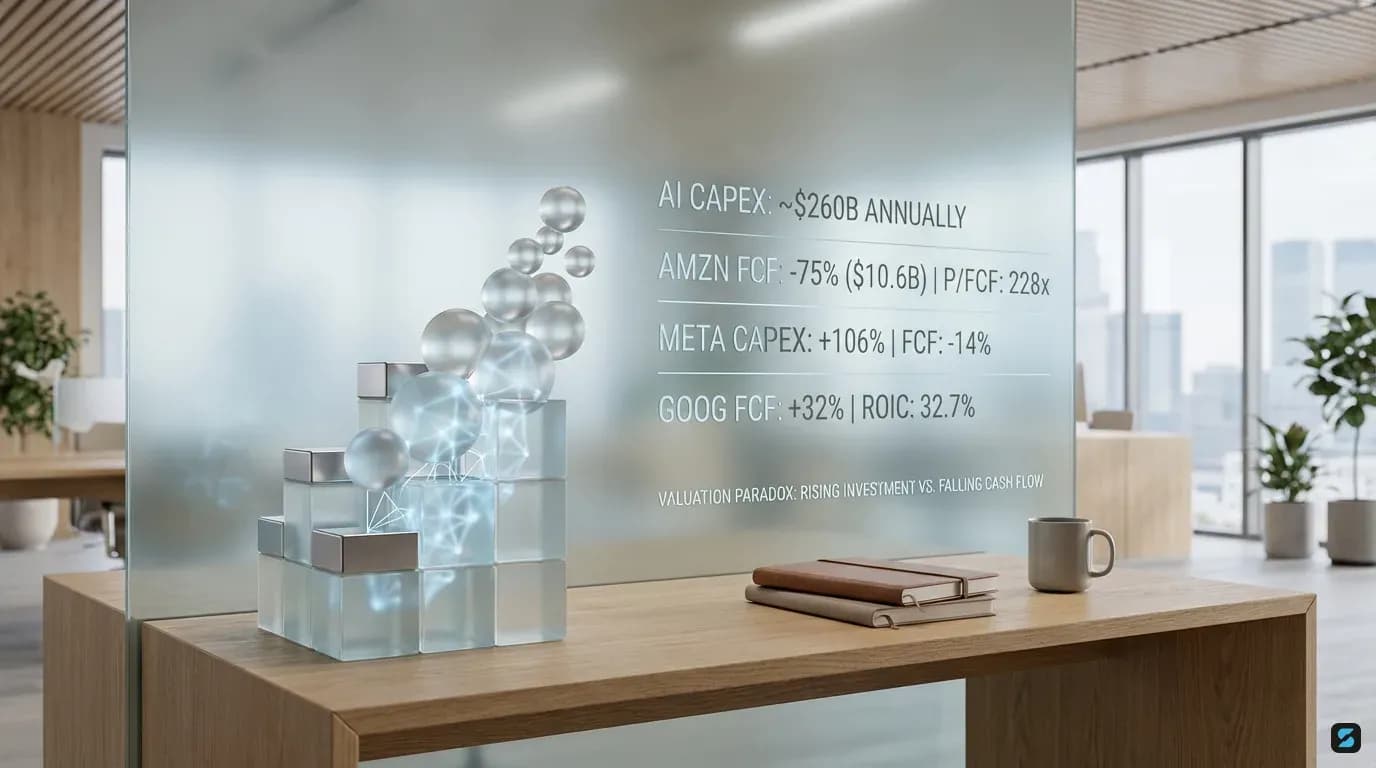
Is the AI hype masking a dangerous valuation bubble? Discover how massive Capex spending is impacting tech giants' bottom lines and learn how AI-powered options strategies can protect your portfolio and generate income, even in a downturn.
The AI Capex Bubble: A Valuation Paradox in Big Tech
The narrative driving the stock market over the last year has been singular: Artificial Intelligence. But beneath the hype of Large Language Models and generative AI lies a growing financial divergence that every trader needs to understand. We are witnessing a valuation paradox where massive capital expenditures (Capex) are colliding with deteriorating Free Cash Flow (FCF) quality.
For investors and traders, this presents a unique opportunity—and a significant risk. At Stonki, an SEC Registered Investment Advisor, we believe that AI investment advice shouldn't just chase trends; it should analyze the fundamental structural risks that the market ignores.
In this deep dive, we’ll analyze the alarming numbers behind Amazon (AMZN) and Meta Platforms (META), contrast them with Alphabet (GOOG), and discuss how to use options trading strategies and risk management guidance to navigate the upcoming volatility.
The Numbers Don't Lie: The Capex vs. FCF Disconnect
Three of the "Magnificent Seven" are spending a combined ~$260 billion annually on Capex, primarily for AI infrastructure. However, the return on invested capital (ROIC) and cash flow efficiency vary wildly.
1. Amazon (AMZN): The Most Vulnerable
Amazon creates a compelling case for caution. While the stock has performed well, the fundamentals paint a concerning picture:
- Valuation Stretch: Trading at a Price-to-FCF ratio of 228x is incredibly high for a "mature" company.
- FCF Collapse: Free Cash Flow has collapsed 75% to just $10.6B on $691B in revenue. That is a razor-thin 1.5% margin.
- Low Efficiency: AMZN currently sports the lowest ROIC among peers at 17%, despite pouring $120B into annual Capex.
While a 3.49x Price-to-Sales (P/S) ratio might look "cheap" historically, the quality of earnings has deteriorated. The market is pricing AMZN as if it is an asset-light money printer, but it has become a capital-intensive infrastructure beast.
2. Meta Platforms (META): The Danger Zone
Meta is betting the farm on the AI buildout.
- Aggressive Spend: Capex has more than doubled (+106%).
- Margin Risk: The stock trades at 8.79x P/S, assuming they can maintain 43% operating margins. This is highly questionable given the depreciation costs associated with AI hardware.
- Cash Flow Hit: FCF is down 14% despite 21% revenue growth. The Capex is literally eating the bottom line.
3. Alphabet (GOOG): The Exception
Amidst this spending spree, Google stands out as the only giant justifying its multiple:
- Operating Leverage: FCF actually grew 32% despite a 58% increase in Capex.
- High Efficiency: An ROIC of 32.7% suggests efficient capital deployment.
- Fair Valuation: While 9.79x P/S is elevated, the fundamentals support it far better than its peers.
The "Depreciation Cliff" Risk
There is a critical accounting nuance here often referred to as the "Michael Burry Warning."
Many of these tech giants are extending the useful lifespan estimates of their servers and GPUs to smooth out earnings. This makes reported profitability look better than it is. However, AI chips become obsolete faster than traditional servers.
If these companies are forced to accelerate depreciation or write down assets due to obsolescence, we could see massive margin compression. If monetization doesn't accelerate dramatically in the next 12-18 months, multiple contraction of 20-30% is entirely plausible, specifically for AMZN and META.
Transforming Analysis into Action: Your Trading Plan
Identifying the risk is only step one. Step two is structuring a portfolio to handle it. As a non-discretionary advisor, Stonki provides AI-powered investment advice and personalized trading plans, but you remain the captain of your ship, executing trades in your own brokerage account.
Here is how you can utilize options trading strategies to play this thesis:
1. Income-Focused Strategies for Neutral/Bearish Views
If you agree that AMZN or META face valuation compression, simply shorting the stock is risky. Instead, consider selling options for income using defined risk strategies.
- Credit Spreads (Vertical Spreads): You might consider selling call spreads (Bear Call Spreads) above key resistance levels. This allows you to collect premium (income) as long as the stock stays below a certain price.
- Iron Condors: If you believe the stocks will stagnate as the market waits for earnings proof, an Iron Condor allows you to profit from Theta decay strategies (time decay) while the stock remains range-bound.
Stonki Insight: Our AI options advice can help you analyze implied volatility levels to determine if premiums are rich enough to justify the risk of selling spreads.
2. The "Wheel Strategy" for High-Conviction Names
For a company like GOOG, where fundamentals are stronger, you might look for better entry points.
- Cash Secured Puts: You could sell puts at a strike price you are willing to own the stock at (e.g., the $160 level). If the stock dips, you buy it at a discount. If it stays high, you keep the premium.
- Covered Calls: If you already own the stock, selling OTM (Out of the Money) calls can generate weekly options income to buffer against potential volatility.
3. Monitoring with Options Greeks
Understanding options Greeks is vital for risk management:
- Delta: Measures directional risk. If you are worried about a crash, keep your portfolio Delta low or negative.
- Theta: Measures time decay. Income strategies rely on positive Theta—making money as time passes.
How Stonki Helps You Manage This Risk
Navigating a potential valuation reset requires vigilance. Stonki acts as your 24/7 analyst. While we do not execute trades or hold your funds, our AI-powered options recommendations provide the intelligence you need to make informed decisions.
Here is how Stonki supports your trading workflow:
- Personalized Trading Plans: We analyze your financial goals and risk tolerance to suggest whether aggressive strategies (like spreads) or conservative strategies (like covered calls) fit your profile.
- Portfolio Monitoring and Alerts: We can set up strategic checkpoints. For example, Stonki can alert you if AMZN breaks below critical support levels (like $210) or if GOOG dips below $295, signaling a potential trend change.
- Risk Management Guidance: We help you size positions correctly so that a sudden market rotation doesn't wipe out your portfolio.
- Earnings Season Prep: With Q4 earnings approaching in late January, Stonki helps you analyze options flow analysis and unusual options activity to see how the "smart money" is positioning before the reports drop.
The Bottom Line
You have identified a structural risk that the market hasn't fully priced in: AI infrastructure overcapacity.
- AMZN faces FCF quality issues.
- META is spending aggressively with uncertain ROI.
- GOOG remains the fundamental leader.
Don't trade this environment blindly. Use AI investment analysis to structure defined risk options strategies that protect your capital while generating income.
Ready to upgrade your trading toolkit? Let Stonki help you build a personalized plan to monitor these tickers and alert you when the opportunities—or risks—are highest.
Disclaimer: Stonki is an SEC Registered Investment Advisor. All investments involve risk, including the loss of principal. Stonki provides non-discretionary advice and does not execute trades on behalf of users.